An industrial wastewater treatment system cannot be priced from flow alone. Two plants with the same daily volume may need very different equipment because their pollutants, concentration peaks, discharge or reuse targets, site conditions, materials, automation requirements, and residual streams are different.
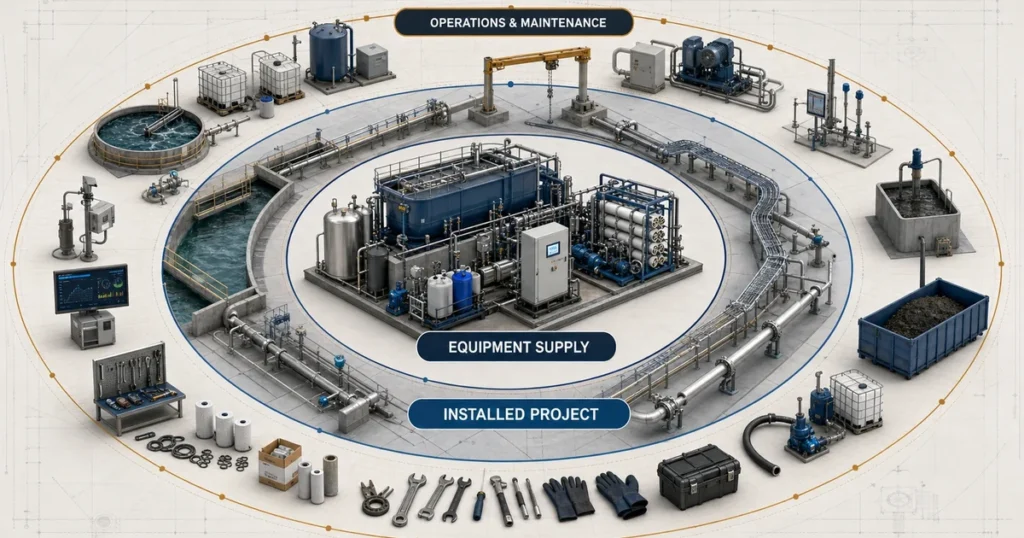
For an industrial buyer, the cost of a wastewater treatment system is best evaluated as an equipment, installed-project, and operating-cost structure—not as one price per unit of flow.
Quick Answer
There is no reliable universal current price for an industrial wastewater treatment system. Cost depends on wastewater composition, average and peak flow, treatment target, process route, site conditions, materials, automation, residual handling, and the agreed supply boundary.
For order-of-magnitude equipment planning, Motiva’s July 2026 model places a compact 3–10 m³/h DAF pretreatment package at approximately USD 12,000–40,000, a 10–50 m³/h physical-chemical treatment package at USD 40,000–180,000, a 50–300 m³/day packaged biological or MBR system at USD 60,000–250,000, and a 300–600 m³/day multi-stage industrial treatment package at USD 180,000–650,000.
These are modeled equipment-supply ranges for early project planning—not historical transaction prices, formal quotations, universal market averages, or complete installed-project costs. The applicable range must remain tied to a stated treatment duty, capacity, material, automation level, included components, and delivery boundary.
Model basis: July 2026, with rounded USD presentation based on an indicative planning conversion of USD 1 = CNY 7.2. Exchange-rate movement and project-specific commercial terms are not included.
| Illustrative Equipment Scope | Capacity Basis | Motiva Planning-Level Equipment Range | Typical Included Scope | Normally Excluded |
|---|---|---|---|---|
| Compact DAF pretreatment package | 3–10 m³/h | USD 12,000–40,000 | DAF unit, recycle pressurization and dissolved-air system, scraper, selected pumps and dosing, basic local controls | Site equalization, civil work, buildings, local piping and cabling, freight, installation |
| Physical-chemical treatment package | 10–50 m³/h | USD 40,000–180,000 | pH adjustment, reaction and flocculation, DAF or clarification, chemical preparation, sludge transfer, instruments and PLC within the stated package | Unknown contaminant-specific polishing, site tanks, sludge disposal, local construction and permitting |
| Packaged biological or MBR system | 50–300 m³/day | USD 60,000–250,000 | Prefabricated biological treatment, aeration, recirculation, membrane separation where selected, pumps, basic instruments and controls | Major industrial pretreatment, advanced reuse polishing, buildings, site installation and local authority costs |
| Multi-stage industrial treatment package | 300–600 m³/day | USD 180,000–650,000 | Coordinated equipment package for defined pretreatment, primary separation, biological or membrane duties, selected polishing and residual handling | Civil structures, site-wide piping and electrical work, international freight, duties, taxes, local installation, permits and owner-side costs |
The first cost question should therefore be: What is included? A supplier’s equipment price is not the same as the total amount required to install, commission, and operate a treatment system.
What Does An Industrial Wastewater Treatment System Cost?
The most useful answer separates four different cost views:
| Cost View | What It Means | Why It Matters |
|---|---|---|
| Equipment price | The treatment units and ancillary equipment included in a supplier’s scope | It is usually only one part of the project budget |
| Total installed cost | Equipment plus the engineering, site, civil, electrical, piping, installation, freight, startup, and owner-side costs included in the defined project scope | It is the better basis for capital planning |
| Annual operation and maintenance (O&M) | Energy, chemicals, labor, maintenance, consumables, monitoring, and residual disposal required during operation | It shows the recurring operating burden |
| Lifecycle cost | Capital expenditure plus operating, maintenance, replacement, and other relevant costs over the evaluation period | It helps compare routes that have different purchase and operating profiles |
For planning purposes:
Total installed cost = equipment supply + engineering + direct installation/civil/electrical work + freight/startup + owner and local costs
Purchased equipment is only one component of a treatment project. Direct installation work, indirect project costs, recurring operation, and periodic replacement must also be considered, and the same cost boundary should be used when comparing alternatives.
How Motiva Builds A Planning-Level Range
A useful planning range begins with comparable current equipment configurations. Capacity, process duty, material, automation, included auxiliaries, and delivery scope are normalized before a price is used as a lower-bound equipment reference. Placeholder figures, deposits, incomplete descriptions, and configurations that cannot be compared on the same basis are excluded.
Motiva then defines a coherent scenario package and applies allowances for the stated auxiliaries, controls, documentation, quality requirements, and engineering integration. Where current listings cannot be normalized across a category, the result remains a Motiva scenario model rather than a source-derived market benchmark.
- Define the wastewater duty and treatment target.
- Normalize capacity, process route, material, automation, and included components.
- Separate equipment supply from freight, installation, civil work, and owner-side costs.
- Apply engineering and uncertainty allowances to the stated supply boundary.
- Replace the planning range with a project-specific quotation after the design basis is reviewed.
The model is an early planning tool, not a generic price-per-flow multiplier. A project quotation still begins with the water data, treatment target, site, material requirements, and agreed interfaces.
Separate Equipment Price From Total Installed Project Cost
A useful quotation comparison begins with a common boundary. If one proposal includes process equipment only and another includes tanks, controls, installation supervision, and commissioning, their headline totals do not represent the same purchase.
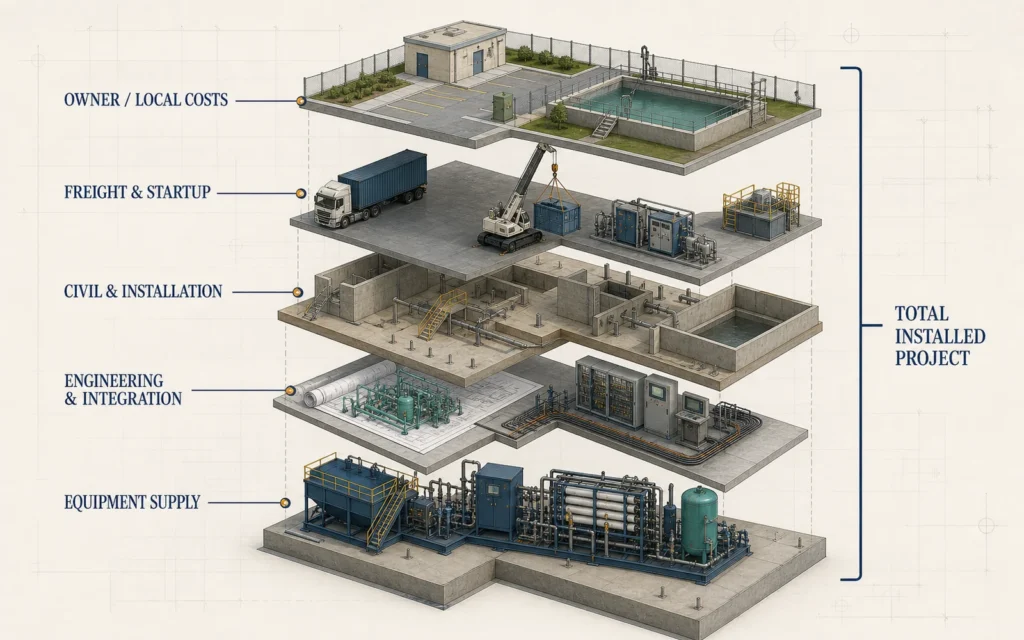
| Cost Layer | Typical Inclusions | Usually Quoted By | Input Needed | Common Exclusion |
|---|---|---|---|---|
| Equipment supply | Main process units, pumps, blowers, mixers, dosing units, instruments, control panels, and specified ancillary equipment | Equipment manufacturer or system supplier | Flow, water analysis, route, materials, redundancy, automation, and interface requirements | Civil work, buildings, site piping, local electrical installation, permits |
| Engineering and integration | Process review, equipment configuration, layout, interface definition, drawings, control philosophy, and documentation within the agreed scope | System supplier, process designer, or EPC contractor | Design basis, standards, site data, utilities, battery limits, and documentation requirements | Detailed local civil design, authority review, or third-party engineering outside the contract |
| Civil work and installation | Foundations, tanks, structures, buildings, lifting, erection, interconnecting piping, cabling, and utility connections | Local contractor or EPC contractor; sometimes partly included by the system supplier | Geotechnical data, site survey, layout, construction standards, access, and local rates | Unknown ground conditions, production shutdown work, buried obstructions |
| Freight and delivery | Packing, inland or international transport, insurance, customs-related services, and final delivery as agreed | Manufacturer, freight provider, importer, or buyer | Delivery destination, Incoterm, dimensions, weights, route restrictions, and schedule | Duties, taxes, port storage, local unloading unless specifically included |
| Startup and handover | Installation checks, dry and wet commissioning support, training, documentation, and performance verification within the agreed basis | System supplier, local integrator, or EPC contractor | Mechanical completion status, utilities, seed sludge or chemicals, influent availability, and operator readiness | Extended operation, laboratory charges, repeat visits caused by incomplete site readiness |
| Owner and local costs | Land, permits, laboratory testing, local professional services, utility upgrades, connection fees, contingency, financing, and internal project resources | Owner and local project team | Jurisdiction, discharge route, company standards, and financing plan | Often absent from equipment quotations |
When reviewing wastewater treatment systems and equipment, compare the process duty, supporting pumps and dosing, materials, instruments, controls, spare parts, drawings, documentation, and interface points—not only the name of the main treatment unit. The proposal should also identify who confirms the process basis and who coordinates each site interface.
Deep foundations, limited access, existing-plant modifications, long pipe runs, hazardous-area requirements, transport limits, or a tight shutdown window can materially change installed cost. For an export package, local civil work, permitting, installation, taxes, and owner-side costs may remain outside the equipment proposal. Startup boundaries should state the requirements for mechanical completion, utilities, chemicals, laboratory support, influent, and operator readiness.
The Project Inputs That Change The Budget Most
Flow is the starting point, not the design. The cost changes when the design must handle a difficult pollutant, a higher peak, a stricter target, a corrosive environment, or a more demanding reliability requirement.
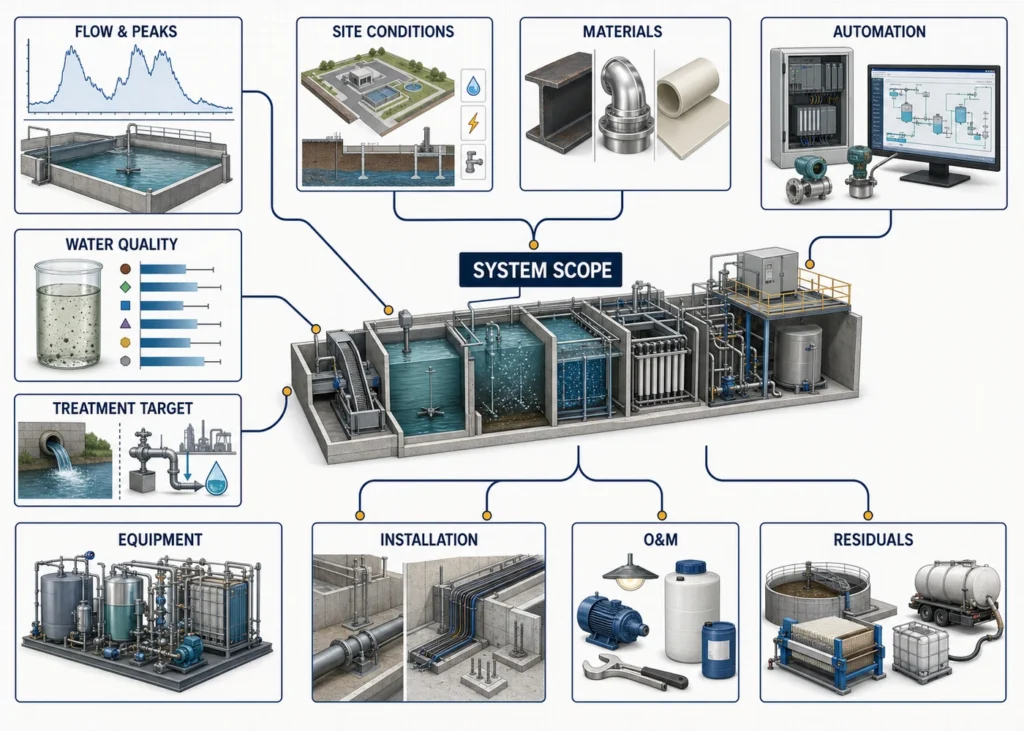
| Input | Why It Matters | Likely Cost Layer Affected | What To Provide |
|---|---|---|---|
| Average flow, peak flow, and operating schedule | Determines hydraulic sizing, equalization, batch storage, turndown, and number of operating trains | Equipment, tanks, civil work, energy | Daily average, hourly peak, batch volume, operating hours, seasonal profile |
| Wastewater composition and variability | Determines pretreatment, biological loading, chemical demand, membrane protection, and residual generation | Process equipment, chemicals, sludge handling, monitoring | Representative laboratory data, production sources, high/low values, abnormal events |
| Discharge, reuse, recovery, or ZLD target | Determines the required treatment depth and verification burden | Treatment stages, instrumentation, polishing, residual management | Applicable limits, receiving route, reuse specification, recovery target |
| Treatment train and redundancy | Changes the number of units, standby equipment, controls, and operational flexibility | Equipment, controls, footprint, maintenance | Availability target, allowable downtime, N+1 requirements, maintenance strategy |
| Site and footprint | Affects layout, tank form, pumping, foundations, buildings, access, and installation sequence | Civil, piping, structural, freight, installation | Site plan, elevations, available area, access, geotechnical information |
| Material and corrosion conditions | Changes tank, piping, pump, coating, and fastener selections | Equipment and replacement cost | pH, chlorides, temperature, solvents, oxidants, outdoor environment |
| Utilities and automation | Affects electrical load, chemical systems, instrumentation, staffing, and remote support | Equipment, electrical, controls, O&M | Power supply, compressed air, water, steam, staffing model, control requirements |
| Residual disposal route | Determines dewatering, storage, concentration, hauling, or recovery needs | Equipment, civil work, consumables, recurring disposal | Sludge characteristics, concentrate volume, disposal acceptance criteria and fees |
A plant producing 500 m³/day evenly over 24 hours is not hydraulically identical to one discharging the same volume in two short shifts. Equalization can reduce downstream peaks but adds tank volume, mixing, pumping, instrumentation, and site work. Representative data from normal production, cleaning, product changeover, and peak-load events is therefore more useful than a single sample or daily average.
The required discharge, reuse, recovery, or ZLD target determines treatment depth and verification needs. Standby equipment, compact layouts, corrosion-resistant materials, higher automation, and difficult delivery conditions can also increase equipment or project cost. Their value should be judged against downtime risk, staffing, maintenance capability, site constraints, and lifecycle requirements.
How The Treatment Route Changes Cost
The treatment route connects water quality to cost. Every stage can add equipment, utilities, chemicals, controls, maintenance, and a residual stream. The lowest equipment count is not automatically the lowest reliable lifecycle cost.
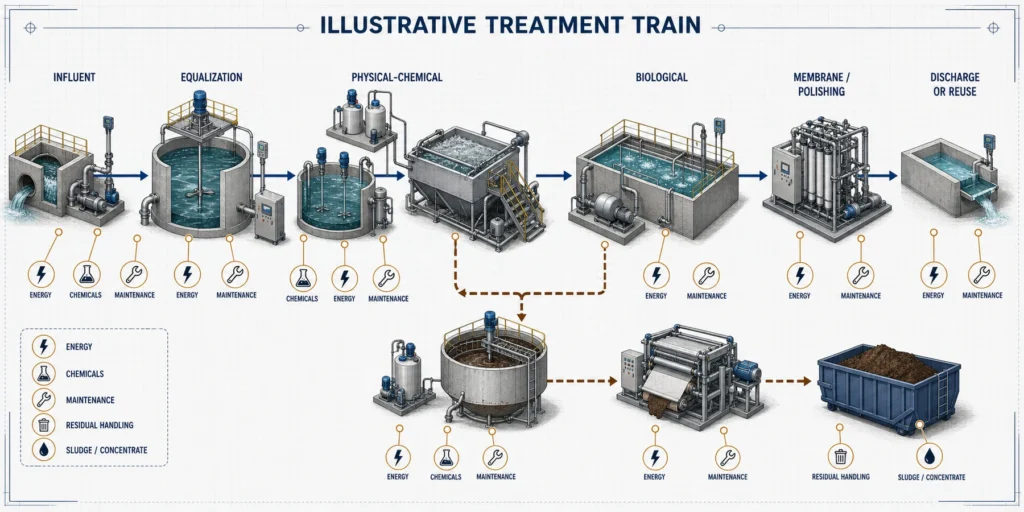
| Treatment Duty | Typical Process Role | Cost Points To Review | Residual Or Downstream Consequence |
|---|---|---|---|
| Screening, equalization, oil separation, pH adjustment | Protect and stabilize downstream treatment | Tanks, mixers, screens, pumps, DAF or separators, dosing, instruments | Screenings, skimmed oil, chemical consumption, primary sludge |
| Physical-chemical clarification and metals removal | Remove suspended matter, precipitated metals, or selected contaminants | Reaction tanks, dosing, clarification, sludge transfer and dewatering | Chemical sludge, filter cake, disposal classification |
| Biological treatment | Convert biodegradable organic load and, where required, nutrients | Reactor volume, aeration, carriers or membranes, recirculation, controls | Waste biological sludge, aeration energy, startup and biomass management |
| Membrane separation and reuse polishing | Separate fine particles or dissolved constituents to meet a higher water-quality target | Pretreatment, membrane area, pressure or aeration, cleaning, instruments, replacement | Backwash, cleaning waste, concentrate or reject stream |
| Advanced oxidation or adsorption | Treat selected refractory or trace contaminants | Oxidants, energy, reactors, media, safety systems, monitoring | Spent media, oxidation by-products, off-gas or chemical residuals |
| Evaporation, concentration, recovery, or ZLD route | Reduce liquid discharge and potentially recover water or material | Pretreatment, thermal or membrane concentration, crystallization, materials, high-load utilities | Concentrate, salt or solids handling, cleaning and disposal |
Pretreatment can determine whether downstream biological or membrane stages operate reliably. Membranes may support compact separation or reuse, but pretreatment, cleaning, concentrate handling, and replacement belong in the cost review. Advanced oxidation and ZLD-related routes require careful definition of feed, target, recovery, energy, material, and residual handling.
To understand the roles and limitations of individual processes before budgeting them, review industrial wastewater treatment routes and compare wastewater treatment system options.
How To Estimate Operating Cost Per Cubic Meter
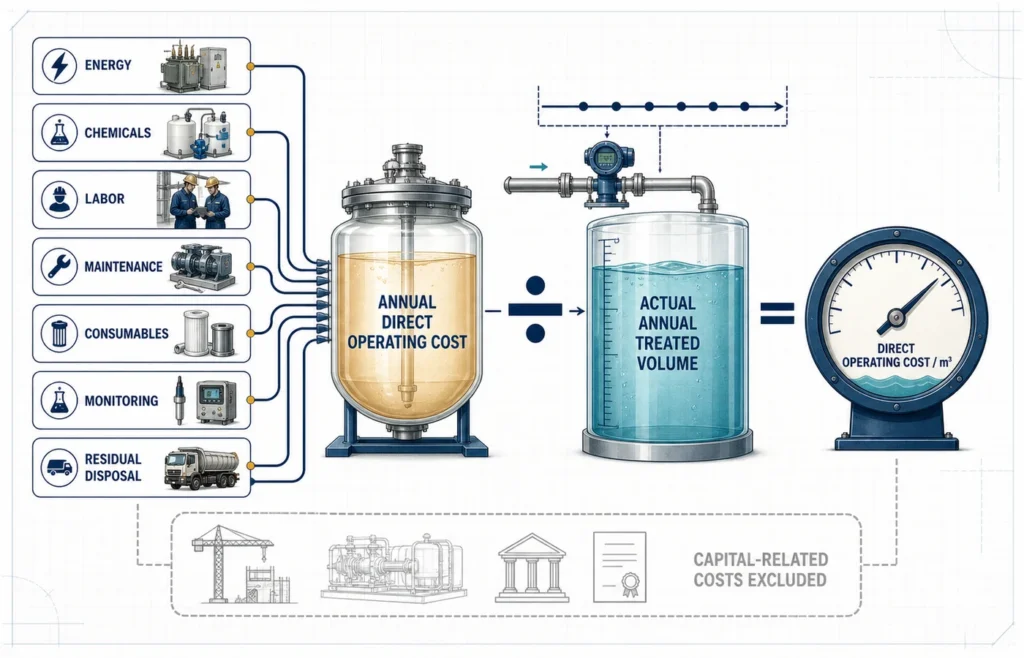
Industrial wastewater treatment cost per m³ should be calculated from the annual operating basis:
Operating cost per m³ = (energy + chemicals + labor + maintenance + consumables and replacement + monitoring + sludge/concentrate disposal) ÷ actual annual treated volume
The numerator and denominator must cover the same period. Dividing annual cost by nominal design capacity can understate unit cost when the plant operates intermittently, below capacity, or only during part of the year.
Illustrative Operating-Cost Example
Assume a plant treats 100,000 m³/year. Annual direct operating costs are USD 60,000 for energy and chemicals, USD 35,000 for labor and maintenance, and USD 25,000 for sludge disposal and monitoring.
Direct operating cost = USD 120,000 ÷ 100,000 m³ = USD 1.20/m³
This calculation is illustrative only. It is not a Motiva project benchmark and excludes capital recovery, depreciation, financing, and taxes.
Energy, Chemicals And Labor
Energy may be consumed by pumping, aeration, mixing, membranes, dewatering, or evaporation. Chemicals may include pH control, coagulants, nutrients, antiscalants, cleaning agents, oxidants, and sludge conditioners. Labor should cover sampling, preparation, cleaning, residual handling, troubleshooting, and supervision.
Maintenance, Consumables And Replacement
Maintenance includes planned service, calibration, repairs, and wear parts. Consumables and periodic replacements may include media, membranes, cartridges, lamps, electrodes, seals, or instruments. Intervals should reflect water conditions and operating practice.
Sludge, Concentrate And Residual Disposal
Chemical treatment produces sludge, biological systems produce excess biomass, membranes produce backwash or concentrate, and adsorption creates spent media. Include storage, dewatering, analysis, transport, and disposal or recovery. Reducing liquid volume may still create a concentrated residual requiring controlled management.
Monitoring, Testing And Compliance Administration
Sampling, analysis, calibration, reporting, permits, and compliance administration can be recurring costs. Requirements depend on the discharge route and local rules.
Why Utilization Changes The Unit Cost
Consider two systems designed for the same nominal daily capacity. If one treats water continuously near design load while the other runs only during short campaigns, their annual labor, maintenance, and fixed costs are divided by different treated volumes. The second system may therefore have a higher cost per m³ even if its equipment price is similar.
Before comparing two O&M figures, confirm:
- Actual annual treated volume and operating hours
- Influent and effluent basis
- Electricity and chemical unit prices
- Chemical dose assumptions
- Labor hours and labor rate
- Sludge, concentrate, and disposal basis
- Maintenance and replacement allowance
- Monitoring and testing requirements
- Whether depreciation, financing, taxes, or capital recovery are included
Without these inputs, a universal cost-per-m³ figure is more likely to mislead than help.
New System, Upgrade Or Replacement?
An upgrade may retain useful assets, but integration and hidden-condition risk can reduce the expected saving. The decision should be based on the existing system’s hydraulic capacity, structural condition, process performance, controls, and compatibility with the new target.
| Situation | Likely Path | Cost Information Needed | Key Uncertainty |
|---|---|---|---|
| Existing tanks and hydraulics remain suitable | Upgrade or add process stages | Existing drawings, condition, flow, and failed target | Integration and hidden condition |
| Capacity is adequate but the effluent target changed | Retrofit or add a polishing stage | Current performance, new target, variability, and available interfaces | Whether upstream treatment is stable enough |
| System is undersized or frequently failing | Replacement or major expansion | Peak flow, downtime, equipment condition, and new design basis | Reuse value of existing assets |
| New facility or new wastewater source | New system | Full wastewater, production, site, and discharge basis | Early scope maturity |
An upgrade review should identify which tanks, pumps, blowers, piping, electrical systems, controls, and buildings can be reused. It should also confirm whether keeping an old asset introduces reliability or interface costs. There is no universal payback period for upgrading instead of replacing.
What An Early Estimate Can And Cannot Confirm
An early cost figure is useful when its maturity and exclusions are clear. Estimate reliability improves as the wastewater, process route, equipment scope, site, and commercial boundaries become better defined.
| Estimate Stage | What It Can Support | Typical Basis | What It Cannot Confirm |
|---|---|---|---|
| Search-stage benchmark | Initial scale and feasibility discussion | Public examples, broad flow, industry, and treatment concept | Project price, final route, compliance, or complete scope |
| Budgetary system review | Internal capital planning and option screening | Representative water data, average and peak flow, target, preliminary route, site, material, and supply boundary | Final quantities, all local costs, firm schedule, or contract price |
| Preliminary proposal | Supplier comparison and project development | More complete design basis, equipment list, interfaces, preliminary layout, utilities, and exclusions | Final construction cost or unqualified performance commitment |
| Detailed quotation or contract-stage scope | Purchasing and contract evaluation | Agreed technical basis, drawings, specifications, battery limits, commercial terms, schedule, and responsibilities | Unknown site conditions or changes outside the agreed basis |
A budgetary review can identify the likely treatment route, major equipment, material direction, known exclusions, and the information still missing. It cannot guarantee the final price, permit outcome, operating cost, or effluent performance before the technical and commercial basis is agreed.
Data Needed For A Budgetary System Review
The fastest way to improve an estimate is to improve its inputs. Prepare:
- Wastewater source and the production or cleaning process that creates it
- Average flow, peak flow, batch volume, and operating schedule
- Representative water analysis, including normal and peak conditions
- Required discharge, reuse, recovery, or ZLD target
- Site location, available footprint, elevations, access, and climate
- Material and corrosion constraints
- Available power, water, air, steam, and other utilities
- Existing equipment, drawings, condition information, and performance data for an upgrade
- Preferred delivery model and supply boundary
- Required redundancy, automation, documentation, and schedule
Use the wastewater treatment RFQ input checklist to organize the full data package. If the route is still uncertain, compare wastewater treatment system options or review wastewater treatment project design support before requesting a detailed quotation.
How Motiva Reviews A Wastewater Treatment Budget
Motiva begins with the wastewater and project basis, not a generic price per unit of flow. Our review normally considers:
- Wastewater source, representative analysis, average flow, peak flow, and operating pattern
- Discharge, reuse, recovery, or residual-management target
- Preliminary treatment route and major process duties
- Equipment scope, material direction, redundancy, controls, and layout constraints
- Utilities, delivery conditions, site interfaces, and the proposed supply boundary
- Known exclusions and information required for the next estimate stage
The output may support an early equipment budget or a more developed preliminary proposal, depending on the quality of the inputs. Actual configuration and pricing depend on wastewater characteristics, flow, target, site, material, utilities, delivery scope, and project requirements.
Motiva can define and quote the agreed equipment and engineering scope. Responsibility for local civil design, construction, permits, installation, and regulatory approval must be assigned specifically for each project and country.
Wastewater Treatment System Cost FAQ
How Much Does An Industrial Wastewater Treatment System Cost?
There is no reliable universal price. In Motiva’s July 2026 equipment-planning model, the illustrative ranges extend from approximately USD 12,000–40,000 for a compact 3–10 m³/h DAF pretreatment package to USD 180,000–650,000 for a 300–600 m³/day multi-stage industrial treatment package. These are modeled equipment-supply ranges—not transaction prices or installed-project totals—and the applicable range still depends on wastewater, flow, treatment target, process route, site, material, automation, included components, and the agreed supply boundary.
What Is Normally Included In The Equipment Price?
It may include main treatment units and selected pumps, blowers, dosing equipment, instruments, controls, and ancillary items. Civil work, site piping, electrical installation, freight, duties, permits, startup, and owner costs may be separate. Always request an inclusion, exclusion, and interface list.
What Is The Difference Between Equipment Price And Total Installed Cost?
Equipment price covers the stated supplier package. Total installed cost adds the engineering, civil work, buildings, piping, electrical work, installation, freight, startup, and owner-side costs included in the project boundary.
How Is Industrial Wastewater Treatment Operating Cost Per m³ Calculated?
Add annual energy, chemicals, labor, maintenance, consumables, replacement, monitoring, and residual-disposal costs, then divide by the actual annual treated volume. This produces a direct operating-cost figure when capital-related costs are excluded.
Does Cost Per m³ Include Capital Cost?
Not always. A direct operating-cost figure normally excludes capital recovery, depreciation, financing, and taxes. A levelized or lifecycle unit cost should include annualized capital cost and use a defined evaluation period and financial basis. Confirm the cost boundary before comparing two per-m³ figures.
Which Wastewater Characteristics Increase Treatment Cost?
High or variable pollutant loads, oil, difficult-to-biodegrade COD, metals, salinity, extreme pH, temperature, solvents, toxicity, and stringent reuse or discharge targets can add treatment stages, materials, controls, utilities, and residual handling. The effect depends on the complete wastewater profile.
Is Upgrading An Existing Treatment System Cheaper Than Replacement?
It can be when useful tanks, hydraulics, equipment, and utilities remain suitable. Hidden deterioration, inadequate capacity, incompatible controls, or difficult integration can reduce the saving. An upgrade decision requires a condition and performance review.
What Information Is Needed For A Budgetary Wastewater Treatment Estimate?
Provide the wastewater source, representative analysis, average and peak flow, operating schedule, treatment target, site, material constraints, utilities, existing assets, delivery location, and preferred supply boundary.
Request A Budgetary System Review
If you are preparing a capital plan or comparing treatment options, Motiva can review the wastewater basis, preliminary route, equipment scope, material and layout direction, known exclusions, and remaining information required for a useful estimate.
Send project data through the shared Motiva RFQ / Water Data Form or prepare the wastewater treatment RFQ inputs before submitting the project data.
Actual configuration and pricing depend on wastewater characteristics, average and peak flow, treatment target, site conditions, materials, utilities, delivery scope, local responsibilities, and project requirements.
Basis Of Estimate And Use Limitations
Motiva uses normalized current equipment-supply data as a lower-bound reference, then develops planning scenarios from defined configuration assumptions and engineering allowances. Capacity, process duty, material, automation, included components, and supply boundary must be comparable before a listed price is adopted. Placeholder figures, deposits, incomplete descriptions, and incompatible configurations are excluded.
Unless a table states otherwise, a Motiva planning-level equipment range excludes civil work, local installation, site piping and cabling, buildings, permits, taxes, duties, international freight, local professional services, owner-side costs, financing, and contingency. Currency basis, model date, configuration, inclusions, and exclusions should remain beside every published range.
Modeled ranges support early capital planning and option screening. They are not historical transaction prices, a universal market average, a formal quotation, or a guarantee of final project cost or treatment performance.