100 m3/day Slaughterhouse Wastewater Treatment Project In Hunan
For this pig-farm slaughterhouse project, we combined solid-liquid separation, Anaerobic-Oxic (A/O) biological treatment and coagulant-assisted sedimentation in an integrated system designed for approximately 100 m3/day.
What Motiva Configured For The Project
The route was built around coarse-solids removal, staged biological treatment and final clarification for a high-strength slaughterhouse wastewater source.
Project At A Glance
Confirm The Load, Peaks And Outlet Before Sizing
A new slaughterhouse project should begin with actual production and wastewater data. The daily average alone does not define pretreatment, biological volume or final polishing.
Why Separation, A/O And Sedimentation Were Combined
Each stage addresses a different treatment duty. The sequence protects the biological process, reduces dissolved pollution and separates the remaining solids before discharge.
Remove Coarse Solids First
Front-end solid-liquid separation removes larger suspended material before it reaches pumps and biological zones, reducing blockage risk and avoidable solids loading.
Stage The Biological Duties
The anaerobic zone begins organic breakdown. The oxic zone continues organic oxidation and supports ammonia conversion under aerated conditions.
Clarify After Biology
Coagulant addition helps fine particles and colloids form settleable flocs so gravity sedimentation can improve final solids separation.
How The Factory-Built Unit Supports The Route
The large rectangular enclosure brings the main treatment functions into one equipment form while keeping project interfaces accessible for transport and site connection.
Integrated Carbon-Steel Unit
The project used a large rectangular treatment enclosure prepared as one transportable equipment assembly.
Functions Arranged Around The Stated Route
Solid-liquid separation, A/O treatment and sedimentation were coordinated as distinct duties within the overall project configuration.
Openings And Service Access Prepared At The Factory
The loading views show access doors, ventilation, external connections and support frames prepared around the enclosure.
From Design Through Commissioning
The project scope covered system design, installation, commissioning and after-sales support rather than equipment fabrication alone.
Integrated Treatment Enclosure Prepared For Transport
The second loading angle shows the enclosure scale, adjacent support frames and transport securing before the equipment left the factory.
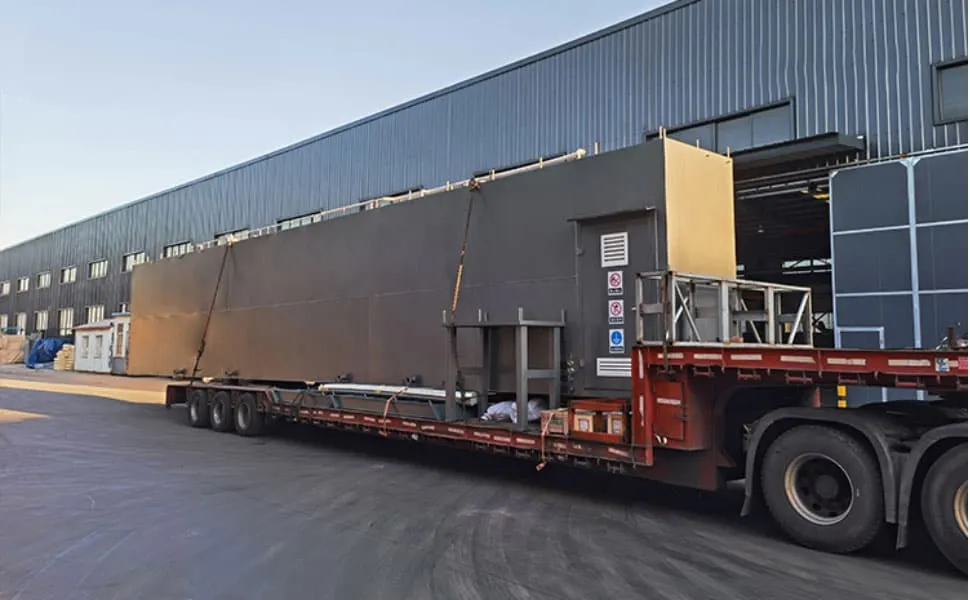
Main Enclosure And Project Frames Loaded Together
The equipment was prepared as a large factory-built assembly. Site lifting, foundations, pipe connections, utilities and solids handling still form part of the installation plan for any comparable project.
Treatment Functions In The Hunan System
The project route addresses coarse solids, biodegradable organic matter, ammonia conversion and final suspended-solids separation without treating the three stages as interchangeable.
We configure the route from the slaughter process, real influent data, peak timing, outlet target, site conditions and the required equipment and service scope.
Results After Installation And Commissioning
The operating project achieved compliant discharge and high removal of the main stated pollutant groups through the combined treatment route.
Compliant Effluent
The treated wastewater met the national discharge requirements stated for the Hunan project.
Organic Pollutant Control
The combined process achieved high-efficiency removal of organic pollutants.
Ammonia And Solids Reduction
Ammonia nitrogen and suspended solids were reduced through the biological and separation stages.
Stable Project Operation
Design, installation, commissioning and after-sales support were coordinated to maintain stable operation.
Installed, Commissioned And Operating
The factory views show the unit before dispatch; the completed project subsequently moved through installation and commissioning into stable operation.
Compare The Project Route With MV-Type And Pretreatment Options
A new slaughterhouse project may use a different equipment form when land, transport, capacity, influent load or expansion requirements change.
Integrated A/O Treatment With Final Sedimentation
The Hunan system was configured around the three treatment duties stated for the project.
Solid-Liquid Separation → A/O Biology → SedimentationThis route achieved the stated project outcome, but a new system still requires its own hydraulic, pollutant-load and outlet review.
30-500 m3/day Modular Vertical Plant Family
MV-Type combines AAO, moving bed biofilm reactor (MBBR), high-efficiency sedimentation and high-efficiency filtration in a multi-module vertical format.
AAO + MBBR → Sedimentation → Filtration ▥ ▥ ▥ ▥The installed Hunan equipment is not identified as MV-Type. For a new slaughterhouse, MV-Type should be evaluated only after solids, blood, oil and grease, peak flow, biodegradability, available footprint and outlet requirements are checked; DAF or other front-end separation may still be required.
Food And Meat Processing Wastewater
Review high organic load, fats, solids, cleaning chemicals, biological treatment and outlet planning for food and slaughter applications.
Evaluate Meat Processing RoutesModular Wastewater Treatment Systems
Compare MV-Type capacity, module grouping, site conditions and the differences between modular vertical and other packaged configurations.
Review MV-Type SystemsDissolved Air Flotation Systems
Evaluate DAF where fats, fine suspended solids and light flocs require stronger front-end separation before biological treatment.
Review DAF PretreatmentProject Design And Equipment Configuration
Prepare flow, wastewater indicators, site limits, target standards and supply scope for a slaughterhouse-specific route review.
Prepare Design InputsWhat To Check Before Planning A Similar System
The next design should respond to the slaughter process, production peaks and measured wastewater load instead of copying the 100 m3/day configuration by capacity alone.
Request A Slaughterhouse Wastewater System Review
Send one set of production, water and site inputs. Our engineering team will review pretreatment, the biological route, equipment form and the interfaces needed for your project.