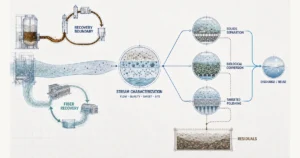
Pulp and paper wastewater can change substantially with raw material, pulping method, bleaching, recovered-fiber use, product grade, water reuse, and the way individual streams are combined. This guide connects those differences to preliminary treatment priorities, operating risks, and the information needed before equipment is selected.
Direct answer: Pulp and paper industry wastewater treatment usually combines process-water recovery, solids separation, biological treatment, and polishing rather than relying on one standard technology. The route changes with the mill process, wastewater stream, fiber and total suspended solids (TSS), biodegradability, color or adsorbable organic halides (AOX), flow variation, and discharge or reuse target. Concentrated recovery streams also require different handling from ordinary mill effluent. Representative data, residual outlets, utilities, and site constraints must be reviewed before a system is configured.
A Typical Pulp and Paper Wastewater Treatment Process
A useful conceptual sequence is:
Identify and segregate streams → recover fiber or process chemicals where practical → screen coarse solids → equalize flow and condition pH → separate suspended or floatable material where needed → apply biological treatment where suitable → add polishing or reuse treatment when required → manage sludge, concentrate, gas, and other residuals
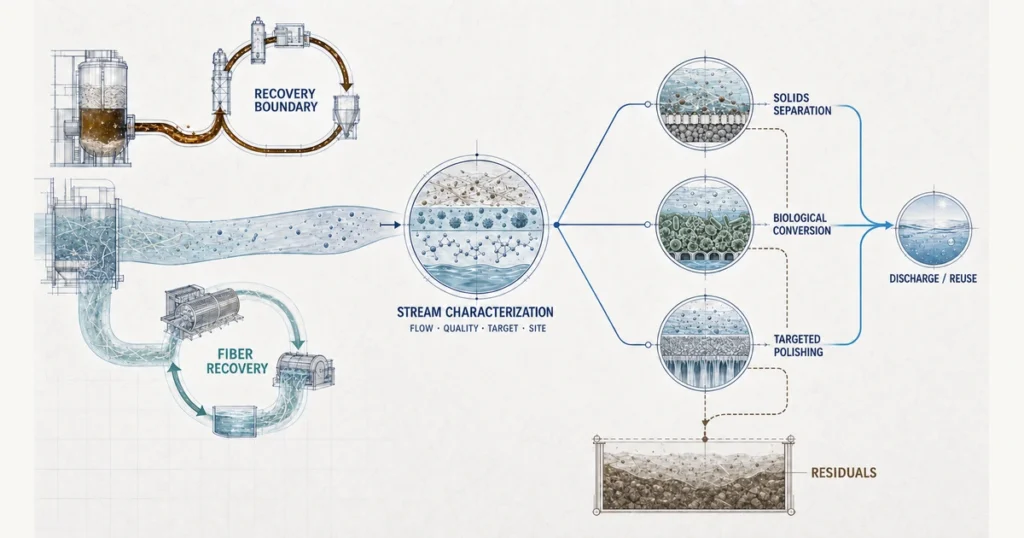
Illustrative decision logic: recovery boundaries and treatment responsibilities vary with the mill stream, wastewater data, project target, and residual requirements.This sequence answers the common question “What does a typical treatment process look like?” without implying that every mill needs every stage.
The route can change in several important ways:
| Route-change signal | Priority treatment task | What remains uncertain | Residual or downstream check |
|---|---|---|---|
| Fiber-rich paper-machine water with high TSS or recoverable solids | Save-all recovery, screening, clarification, or flotation before biological treatment | Fiber value, particle behavior, coagulation response, settling or floatability | Recovered-fiber outlet, screenings, float, sludge, and remaining soluble load |
| Higher-strength wastewater with a biodegradable organic fraction | Evaluate anaerobic conversion before aerobic polishing | Biodegradable fraction, toxicity, temperature, alkalinity, suspended solids, and load variability | Biogas, odor control, anaerobic sludge, and the aerobic or polishing duty that remains |
| Bleaching-related color, AOX, or difficult organics | Source control, segregation, biological feasibility review, and targeted polishing tests | Responsible compounds, biodegradability, toxicity, achievable incremental treatment, and by-products | Chemical residuals, sludge, off-gas, spent media, electrodes, or membrane concentrate |
| A defined reuse target | Add only the filtration, membrane, oxidation, or disinfection barriers required by the end use | Scaling, corrosion, microbial, product-quality, and dissolved-contaminant limits at the reuse point | Concentrate, cleaning waste, reject-water handling, and effects of internal recirculation |
| Highly variable combined mill effluent | Improve source monitoring, diversion control, and equalization before adding treatment capacity | Peak duration, source of the upset, inhibitory events, and whether streams should remain segregated | Equalization residuals, controlled-release procedures, and downstream biological stability |
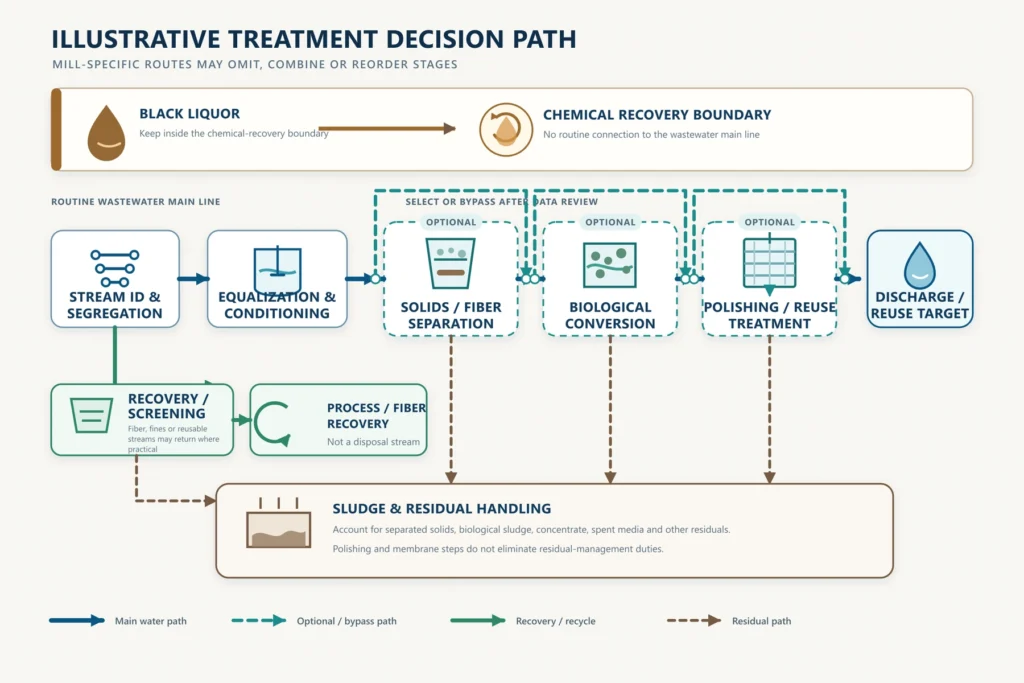
Engineering note: The process sequence, equipment size, chemical dose, hydraulic retention time, expected performance, and residual route must be established from project data. The rest of this guide explains which data change those decisions.
Compare Mill Types and Their Main Treatment Priorities
“Pulp and paper wastewater” is not one uniform influent. The U.S. EPA’s Pulp, Paper and Paperboard Effluent Guidelines divide the industry into process subcategories, including kraft, sulfite, mechanical pulp, non-wood pulp, secondary fiber with or without deinking, and mills using purchased pulp.
The following comparison provides a starting point. Actual wastewater depends on the individual mill, product, chemical program, water circuit, and stream segregation.
| Mill or process context | Important wastewater streams | Signals to investigate | Main preliminary priority |
|---|---|---|---|
| Kraft or other chemical pulping | Pulp washing losses, screening drains, condensates, bleaching streams, spills or controlled diversions | COD, BOD, pH, temperature, color, AOX where applicable, toxicity, conductivity | Protect chemical recovery, segregate concentrated streams, control shocks, evaluate biological treatment and polishing |
| Mechanical pulping | Wood preparation, pulping and paper-machine water | Fibers, TSS, dissolved and colloidal organics, resinous material, temperature | Fiber recovery, solids separation, biodegradability and inhibition review |
| Recycled fiber without deinking | Stock preparation, paper-machine whitewater, cleaning water | Fibers, fines, fillers, TSS, COD, variability | Save-all recovery, screening, solids separation, biological load management |
| Recycled fiber with deinking | Deinking, flotation rejects, washing, stock preparation | Ink particles, fibers, fillers, surfactants, COD, TSS, sludge quantity | Segregate rejects, optimize flotation or clarification, control sludge and downstream biological loading |
| Mills using purchased pulp | Paper-machine whitewater, coating and cleaning water | Fibers, fillers, binders, pigments, intermittent chemical load | Recover fiber, separate solids, equalize batch discharges, verify biological suitability |
| Integrated mill with combined effluent | Mixed pulping, bleaching, papermaking, utility and cleaning streams | Time-series flow, COD/BOD, TSS, pH, temperature, conductivity, toxicity | Identify dominant loads, prevent incompatible mixing, size equalization, protect biological treatment |
This table should be used to frame sampling and engineering questions, not to select equipment from the mill category alone.
Keep Recovery Streams and Wastewater Streams Separate
The difference between a recoverable process stream and wastewater is fundamental in chemical pulping. Sending a concentrated recovery stream to the wastewater plant can waste chemicals, overload biological treatment, increase color and COD, create odor or toxicity problems, and destabilize the entire system.
| Stream | What the term means | Normal management direction | Wastewater-treatment boundary |
|---|---|---|---|
| Black liquor | Spent alkaline pulping liquor containing cooking chemicals and dissolved wood-derived material | Chemical recovery rather than routine wastewater treatment | Prevent losses; contain spills and manage only unavoidable or controlled diversions through the mill’s approved best management practice (BMP) and protection plan |
| Weak black liquor | Lower-solids spent liquor recovered after pulp washing | Evaporation and concentration within the recovery cycle | It should not be treated as ordinary continuous wastewater treatment plant (WWTP) influent |
| Strong black liquor | Concentrated liquor after evaporation | Further concentration and recovery-boiler handling | Outside the normal wastewater-treatment route |
| Foul condensate | Condensate from digester, evaporator, or related process areas containing volatile organics or reduced-sulfur compounds | Segregation, steam stripping, reuse, controlled treatment, or another mill-specific route | Determine contaminant load, odor and hazardous-air-pollutant (HAP) controls, reuse opportunity, and whether biological treatment is appropriate after pretreatment |
| Paper-machine whitewater | Water containing fibers, fines, fillers, and additives from sheet forming and associated operations | Save-all recovery and internal reuse where water quality permits | A purge or unrecovered fraction may require solids separation and downstream treatment |
| High-strength process or cleaning stream | Intermittent concentrated wastewater from production, maintenance, grade changes, cleaning, or an upset | Source control, segregation, controlled release, recovery, or separate treatment | Do not blend blindly into the main sewer; quantify peak load, toxicity, pH, temperature, and equalization need |
EPA technical materials on spent pulping liquor management describe weak black liquor as part of the recovery cycle and emphasize controls for black-liquor losses, spills, leaks, and intentional diversions. They also distinguish condensate collection and treatment from routine combined-effluent handling. These boundaries should be confirmed against the mill’s current recovery system, BMP plan, air controls, permit, and operating procedures.
Whitewater follows a different logic. It is generally a fiber- and fines-bearing process-water stream associated with the paper machine. A save-all is a recovery device used to capture fiber and suspended material so that clarified water or recovered solids can be returned where process quality allows. Internal reuse can reduce fresh-water demand and end-of-pipe loading, but dissolved contaminants can accumulate if water circuits are closed without controlling deposits, corrosion, odor, microbial growth, and product-quality effects.
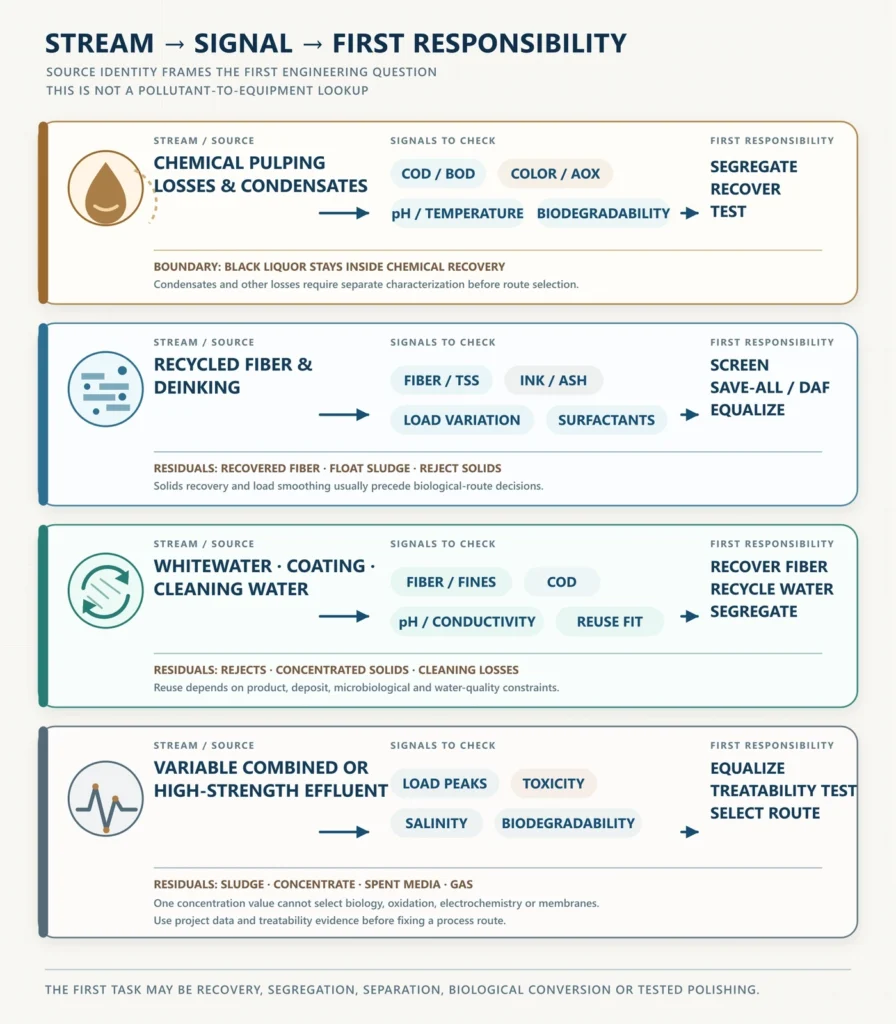
Map Pollutant Signals to Treatment Tasks
Water-quality data are useful only when connected to the wastewater source and the treatment task.
COD means chemical oxygen demand. BOD means biochemical oxygen demand. Their relationship helps characterize how much of the organic load may be biologically treatable, but it does not select a process by itself. AOX refers to adsorbable organic halides and is relevant to particular processes and regulatory subcategories rather than every paper mill.
Fibers, TSS, and Colloidal Material
Fibers and suspended solids can consume treatment capacity, increase sludge production, and carry organic load downstream. They may also have recovery value if captured before dilution or contamination.
TSS concentration alone is not enough. Particle size, density, surface chemistry, coagulation response, settling behavior, and floatability help determine whether screening, a save-all, clarification, or flotation should be evaluated. Where the stream contains light flocs, fine fiber, colloids, oil, or poorly settling material, a dissolved air flotation system may be one separation option.
Dissolved air flotation (DAF) addresses a separable fraction. It does not remove all dissolved COD or establish final biological or reuse performance. The resulting float must also have a practical recovery, dewatering, or disposal route.
COD, BOD, and Biodegradability
A high COD value does not automatically justify anaerobic treatment, and a low BOD/COD relationship does not automatically justify advanced oxidation. Biological feasibility also depends on:
- bioavailable nitrogen and phosphorus;
- residual oxidants or cleaning chemicals;
- resinous or inhibitory compounds;
- pH and alkalinity;
- temperature;
- salinity or conductivity;
- hydraulic and organic-load peaks;
- required effluent quality;
- sludge and gas handling.
Some pulp and paper effluents, particularly certain kraft-mill streams, can be deficient in bioavailable nitrogen or phosphorus for stable biological treatment. A kraft-mill activated-sludge study indexed by EPA HERO examines how nitrogen and phosphorus limitation affects biomass. Nutrient supplementation may therefore be evaluated, but a universal BOD:N:P dosing ratio should not be applied without wastewater data and process monitoring. Underfeeding can limit biomass activity and floc quality; overfeeding can waste chemicals and increase nutrient discharge.
Color, Lignin, AOX, and Difficult Organics
Color can remain after biological treatment when the compounds responsible are poorly biodegradable, when their molecular structure resists the selected biological conditions, or when the biological stage was designed mainly for another treatment task.
Trace the color and difficult-organic load back to its source before selecting a polishing process. Source control, segregation, biological treatment, electrochemical treatment, oxidation, adsorption, or membranes may play different roles. A dose-response or treatability test should show whether an advanced stage creates useful incremental treatment and what residuals it produces.
pH, Temperature, Salinity, Chemicals, and Load Variation
Monthly averages can hide the events that upset a wastewater treatment plant. Cleaning discharges, liquor losses, bleaching sequences, resinous material, surfactants, oxidants, and grade changes can produce short-duration peaks.
Record when samples were collected and which process was operating. Time-series flow, pH, temperature, conductivity, COD, BOD, and TSS data can reveal whether the problem is insufficient treatment capacity, poor equalization, an uncontrolled process loss, or an inhibitory stream.
Match Common Treatment Processes to Their Roles
The BioResources review of pulp and paper wastewater treatment and reclamation describes primary clarification, flotation, activated sludge, anaerobic treatment, oxidation, membranes, process-water recovery, and other approaches used across the industry.
| Process or stage | Main role | Conditions that matter | Main limitation or residual |
|---|---|---|---|
| Screening and save-all recovery | Capture coarse solids, fiber, fines, or recoverable material | Particle size, recoverability, flow, screenability | Screenings or recovered solids need an outlet |
| Equalization and conditioning | Reduce hydraulic, organic, temperature, pH, or chemical shocks | Peak duration, mixing, tank material, corrosion, chemical demand | Does not remove the main pollutant load by itself |
| Coagulation, DAF, or clarification | Separate suspended, colloidal, floatable, or settleable material | Jar testing, floatability, settling, sludge properties | Produces float or sludge; soluble contaminants remain |
| Activated sludge | Aerobic removal of suitable biodegradable organics | Oxygen, nutrients, temperature, toxicity, sludge age, settling | Aeration energy, waste sludge, bulking or foaming risk |
| UASB, EGSB, or IC-type anaerobic treatment | Convert suitable higher-strength biodegradable organic load | Temperature, alkalinity, toxicity, loading, granulation, start-up | Biogas and odor control; downstream treatment usually remains |
| MBBR | Carrier-based attached-growth biological treatment | Carrier retention, loading, oxygen or mixing, reactor zoning | Requires pretreatment and downstream solids management |
| MBR | Biological treatment with membrane solids separation | Pretreatment, flux, fouling, air scour, cleaning, dissolved contaminants | Cleaning waste, sludge, energy; salts and some dissolved compounds remain |
| Oxidation or electrochemical treatment | Address a defined residual-organic, color, toxicity, or biodegradability task | Compound profile, pH, voltage/current or oxidant demand, reaction time, testing | Chemical or electrical demand, by-products, off-gas, media or electrode management |
| Membranes and reuse polishing | Produce water for a defined downstream use | Fouling, scaling, dissolved solids, recovery target, pretreatment | Concentrate and cleaning waste remain |
| Sludge and residual handling | Stabilize, dewater, recover, transport, or dispose of residuals | Quantity, composition, dewaterability, outlet requirements | Determines storage, chemicals, dewatering, transport, and disposal scope |
Use this table as a fit screen, not as a list of stages to combine automatically. DAF is not a substitute for treatment of a mainly dissolved load. Anaerobic treatment is a poor starting assumption when the organic fraction is not sufficiently biodegradable or the wastewater cannot support stable biomass. Aerobic treatment should not be expected to absorb uncontrolled toxic, pH, temperature, or liquor shocks. Membranes should not be used to compensate for preventable upstream fiber, oil, scaling, or colloidal fouling. Oxidation or electrochemical treatment should not be specified before the residual compound and treatment objective are defined and tested.
Anaerobic Treatment: UASB, EGSB, and IC
Upflow anaerobic sludge blanket (UASB), expanded granular sludge bed (EGSB), and internal-circulation (IC) reactors are common names in higher-rate anaerobic treatment. They differ in hydraulic and solids-retention behavior, reactor configuration, recirculation, and loading capability.
The presence of a high COD value is not enough to choose among them. The biodegradable fraction, temperature, suspended solids, toxicity, sulfate or other competing reactions, alkalinity, start-up requirements, granular-sludge behavior, biogas handling, and downstream polishing target all matter.
Aerobic Treatment: Activated Sludge, MBBR, and MBR
Conventional activated sludge relies on suspended biomass and downstream solids separation. It is widely understood and flexible but can be affected by nutrient imbalance, toxicity, oxygen limitation, sludge bulking, foaming, and poor settling.
A moving bed biofilm reactor (MBBR) uses suspended carriers to support attached biomass. Carrier fill, retention screens, reactor zoning, oxygen or mixing duty, and downstream solids separation are project-specific. For product-level information, review Motiva’s MBBR wastewater treatment systems.
A membrane bioreactor (MBR) combines biological treatment with membrane solids separation. It can support a compact configuration and low-suspended-solids effluent when pretreatment and membrane conditions are suitable. It does not automatically remove dissolved salts or every refractory compound. Review Motiva’s MBR wastewater treatment plant configurations separately from the industry-level route.
Advanced Oxidation and Three-Dimensional Electrochemical Treatment
Advanced oxidation or electrochemical treatment should be tied to a defined residual problem, such as color, difficult organics, toxicity, or a biodegradability objective. These processes are not interchangeable, and their incremental benefit should be tested against chemical or electrical demand, by-products, electrode or catalyst stability, sludge, off-gas, and downstream compatibility. A review of three-dimensional electrochemical wastewater treatment describes the particle-electrode concept and the operating variables that affect it.
Motiva’s formal equipment name is STF Series Three-Dimensional Electrolysis Reactor. In technical English, its process can be described as a three-dimensional electrode electrochemical system or particle-electrode electrochemical treatment. Conductive or catalytic particles placed between the main electrodes act as particle electrodes under an applied voltage, increasing the electrochemical reaction interface.
The stated STF application range includes papermaking wastewater. That application listing identifies a possible treatment role; it does not establish where the stage belongs in a specific mill or what performance it will achieve. Water chemistry, target compounds, pH, conductivity, electrode and particle materials, operating conditions, test response, and residuals must be evaluated.
Use Treatability Testing to Reduce Selection Risk
Testing should answer a process-selection question, not simply generate a removal percentage.
Sampling and Mass-Balance Review
Before bench testing, confirm whether the sample represents normal production, a peak event, a segregated stream, or already-combined effluent. A mill-wide flow and COD balance can identify losses or concentrated sources that should be recovered or controlled rather than treated at the end of the pipe.
Jar and Separation Testing
Jar tests can compare coagulants, pH windows, floc formation, settling, and sludge volume. Flotation testing can examine whether the target solids or fibers are sufficiently floatable and how chemical addition affects the float.
Record:
- raw and treated turbidity or TSS;
- COD change where relevant;
- chemical dose and pH;
- float or sludge volume;
- settling or flotation behavior;
- dewatering implications;
- repeatability across representative samples.
Biological Feasibility Testing
Respirometry, biodegradability testing, toxicity screening, nutrient evaluation, and laboratory biological treatment can help determine:
- whether the organic load is biologically available;
- whether an inhibitory stream should be segregated;
- whether nutrient addition is required;
- whether anaerobic, aerobic, or staged biological treatment merits further evaluation;
- what residual COD, color, or toxicity remains for polishing.
Oxidation, Electrochemical, and Membrane Testing
Advanced-treatment tests should track more than one headline parameter. Depending on the objective, review dose or current, pH, contact time, energy, biodegradability change, by-products, electrode or media behavior, membrane fouling, concentrate quality, and downstream effects.
Pilot work may be justified when wastewater varies, scale-up risk is high, or the project target cannot be validated with a short bench test. Public research results are useful for forming the test plan, but they should not be transferred directly to another mill.
Diagnose Common Operating Problems
The same symptom can have several causes. Corrective action should follow operating data, laboratory results, and inspection rather than a generic chemical or equipment recommendation.
| Observed symptom | Possible causes to investigate | Data or checks to review | Treatment implication |
|---|---|---|---|
| DAF carryover or unstable float | Poor coagulation, changing solids, incorrect recycle conditions, overloaded surface, weak floc | Jar test, pH, dose, TSS, recycle pressure/flow, skimmer condition | Re-establish separation conditions before adding downstream capacity |
| Sludge bulking or poor biological settling | Low dissolved oxygen, nutrient imbalance, load variation, septic influent, inhibitory chemicals, unsuitable sludge age | Dissolved-oxygen profile, nutrients, microscopy, sludge volume index (SVI), food-to-microorganism (F/M) trend, influent events, pH and temperature | Correct the biological cause; do not treat every bulking event with one chemical response |
| Reduced biological COD removal | Toxicity, low biodegradability, nutrient limitation, temperature shift, hydraulic or organic shock | COD/BOD, respirometry, nutrients, load history, toxicity screen, biomass condition | Improve source control or biology before assuming an advanced-polishing failure |
| Color remains after biological treatment | Poorly biodegradable color compounds, insufficient source control, unsuitable biological conditions | Color source, process chemistry, AOX where relevant, biodegradability, dose-response tests | Define the residual treatment task before evaluating oxidation or electrochemical polishing |
| Odor or anaerobic instability | Liquor loss, foul condensate shock, sulfate or sulfur compounds, pH/alkalinity loss, temperature or loading upset | Source inspection, oxidation-reduction potential (ORP), pH, alkalinity, temperature, gas composition, load trend | Control the source and stabilize the reactor before increasing load |
| Rapid membrane fouling | Insufficient pretreatment, colloids, fibers, scaling, biomass condition, flux or cleaning problem | TSS, particle behavior, hardness, silica, transmembrane-pressure (TMP) trend, flux, cleaning history | Correct pretreatment and operating causes before adding membrane area |
Nutrient Limitation and Inhibition
Pulp and paper wastewater may contain a substantial carbon load without enough bioavailable nitrogen or phosphorus to support stable biomass. The required nutrient dose depends on the biodegradable load, biomass yield, process configuration, influent nutrients, target, and measured effluent.
Potential inhibitors can include residual pulping or bleaching chemicals, oxidants, resinous compounds, surfactants, cleaning chemicals, high salinity, extreme pH, high temperature, sulfides, or concentrated process losses. The first response should be to identify and control the source. Dilution or chemical addition can hide a recurring process problem without resolving it.
Account for Sludge, Concentrate, Gas, and Reuse
A treatment train is incomplete if it describes only the main water line.
- Screening and save-all systems create screenings or recovered fiber.
- DAF and clarification create float or primary sludge.
- Aerobic treatment creates biological sludge.
- Anaerobic treatment creates biogas, anaerobic sludge, and possible odor-control duties.
- Oxidation or electrochemical treatment can create by-products, spent media, electrode-management needs, gas, or sludge.
- Membranes create concentrate and cleaning waste.
The quantity, composition, dewaterability, storage, reuse potential, transport, and disposal route of each residual should be considered during process selection.
Reuse adds another boundary. Boiler feed, cooling, washing, process-water return, and other uses have different requirements. The reuse point determines which dissolved, particulate, biological, scaling, corrosion, or product-quality risks matter.
The 2015 Journal of Environmental Management review illustrates why operating parameters, sludge treatment, energy, and greenhouse-gas implications belong in a complete treatment comparison. Published results should inform project questions, not serve as performance guarantees for a different mill.
Understand the U.S. Regulatory Starting Point
For U.S. projects, the federal starting point is the EPA’s Pulp, Paper and Paperboard Effluent Guidelines under 40 CFR Part 430. The EPA distinguishes direct dischargers, whose requirements are incorporated into National Pollutant Discharge Elimination System (NPDES) permits, from indirect dischargers that send wastewater to a publicly owned treatment works and may be subject to pretreatment controls.
The EPA identifies multiple industry subcategories and regulated pollutants that can include BOD, suspended solids, pH, COD, AOX, and selected priority or nonconventional pollutants, depending on the subcategory.
This does not create one discharge limit for every mill. Confirm:
- the mill process and applicable subcategory;
- direct or indirect discharge;
- the current permit and local or receiving-authority limits;
- any reuse specification;
- the boundary between process recovery, air-control requirements, BMPs, and wastewater treatment.
This guide provides technical planning information, not legal advice.
Prepare the Data Needed before System Selection
Provide the following information where available. Identify estimated values and explain the production conditions represented by each sample.
Mill and Stream Information
- mill type, raw material, pulp source, and product grades;
- pulping, bleaching, recycled-fiber, deinking, coating, and cleaning operations;
- black-liquor recovery and spill/diversion controls where applicable;
- foul-condensate collection, stripping, reuse, or treatment;
- whitewater and save-all operation;
- segregated streams and the combined discharge point;
- production changes, shutdowns, cleaning events, and expansion plans.
Flow and Water Quality
- average and peak flow with duration;
- batch, shift, weekly, and seasonal variation;
- COD, BOD, and BOD/COD;
- TSS, fibers, particle behavior, settling, or floatability;
- pH, alkalinity, and temperature;
- conductivity or salinity;
- color and AOX where relevant;
- nitrogen and phosphorus;
- oils, resins, surfactants, oxidants, cleaning chemicals, or toxicity concerns;
- sludge, float, concentrate, gas, and cleaning-waste characteristics.
Target, Site, and Supply Boundary
- direct discharge, indirect discharge, or reuse target;
- permit, local limit, or reuse specification;
- existing treatment stages and current bottleneck;
- available footprint, elevations, access, and lifting constraints;
- materials and corrosion requirements;
- power, water, air, heat, chemicals, and other utilities;
- automation and remote-monitoring requirements;
- equipment to retain or modify;
- residual outlets;
- required equipment, engineering, installation, commissioning, training, and documentation scope.
This information supports an initial engineering review. Representative sampling and treatability work may still be required before equipment is sized.
What Motiva Can Support in a Project Review
At Motiva, we can review the wastewater sources, flow, water-quality indicators, treatment target, site limits, material requirements, utilities, existing equipment, and residual outlets before recommending an equipment route.
Our relevant capabilities include:
- GW-Type flotation equipment, with papermaking among its stated applications;
- DAF equipment for suitable separation duties involving light flocs, colloids, oils, or poorly settling material;
- STF Series three-dimensional electrochemical equipment, with papermaking wastewater among its stated applications;
- MBR and MBBR configurations when wastewater characteristics support their biological and separation roles;
- anaerobic equipment evaluation when the organic load, biodegradability, temperature, toxicity, alkalinity, and downstream requirements support that route;
- customized equipment and treatment-stage integration based on flow, layout, material, process, and supply requirements.
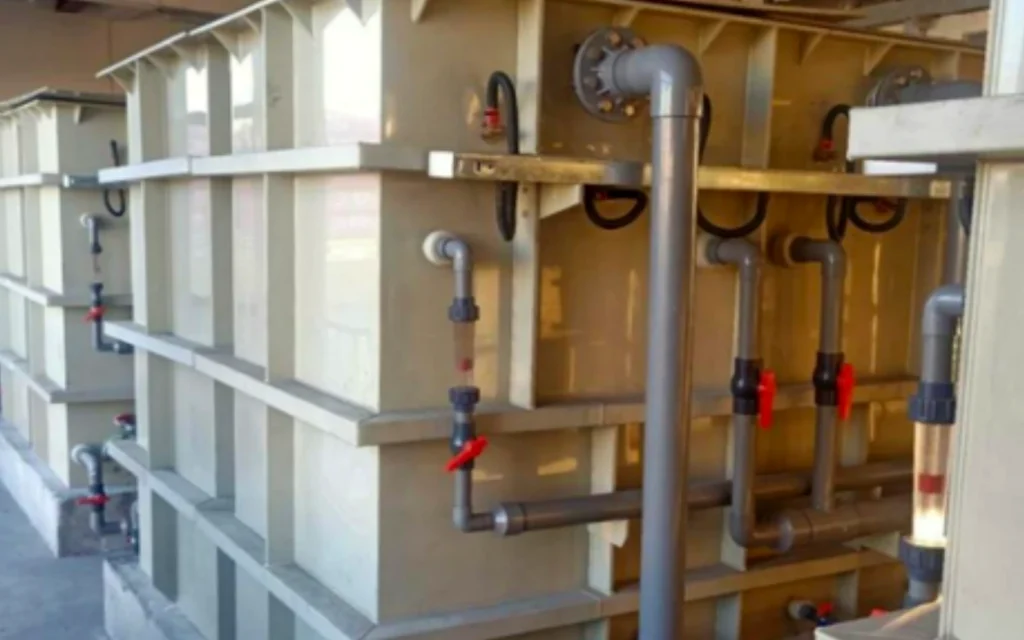
These application listings show where equipment may be evaluated; they do not establish a treatment result for a specific mill. Treatment performance, operating cost, and effluent quality require representative project data and engineering review.
For a project-level route, review our industrial wastewater treatment approach. For broader method roles and limitations, see the industrial wastewater treatment methods guide.
Frequently Asked Questions
What is a typical pulp and paper wastewater treatment process?
A typical decision sequence starts with stream identification and process recovery, followed by screening, equalization, solids separation where needed, biological treatment where suitable, polishing for the final target, and residual management. The actual route changes with mill type, wastewater chemistry, flow variation, discharge or reuse requirements, and site conditions.
Should black liquor enter the wastewater treatment plant?
Black liquor is normally part of the chemical-recovery cycle rather than a routine wastewater stream. Weak liquor is concentrated and recovered, while strong liquor proceeds through the mill’s recovery route. Leaks, spills, maintenance discharges, or controlled diversions can still affect the WWTP and must be managed through collection, recovery, BMP, monitoring, equalization, and protection procedures specific to the mill.
Why can color remain after biological treatment?
Some color-causing compounds are poorly biodegradable or are not removed under the selected biological conditions. Source segregation, improved biological control, or a tested oxidation, electrochemical, adsorption, or membrane-polishing step may be considered after the remaining color source and treatment objective are defined.
Can treated paper mill wastewater be reused?
It may be reused when the treated-water quality matches the actual use. Paper-machine return, washing, cooling, and boiler-related uses have different requirements. Evaluate dissolved solids, hardness, silica, residual organics, color, microorganisms, corrosion, scaling, product quality, concentrate, and cleaning waste before selecting a reuse route.
What causes sludge bulking in paper mill wastewater treatment?
Possible causes include low dissolved oxygen, nutrient imbalance, unsuitable sludge age or loading, septic influent, inhibitory chemicals, temperature or pH shifts, and poor settling conditions. Review the influent event history, dissolved oxygen, nutrients, biomass, SVI, microscopy, and operating trend before selecting a corrective action.
What data are needed before selecting a treatment system?
Send the mill processes and wastewater streams, average and peak flow, representative laboratory data, production variation, existing treatment, target, site and material constraints, utilities, and planned outlets for sludge and other residuals. Identify estimated values and explain the operating conditions represented by each sample.
How This Guide Was Prepared
This guide combines:
- current U.S. EPA industry and effluent-guideline information;
- peer-reviewed reviews and research on pulp and paper wastewater;
- Motiva product documentation and application boundaries;
- engineering decision logic based on wastewater source, data, treatment task, site conditions, and residual management.
The article distinguishes industry-wide technical information from Motiva equipment application information.
Sources and Further Reading
- U.S. EPA: Pulp, Paper and Paperboard Effluent Guidelines — federal category, process subcategories, regulated-pollutant context, and direct/indirect discharge pathways. EPA page last updated March 24, 2026; source reviewed for this article July 28, 2026.
- U.S. EPA: Technical Support Document for Best Management Practices for Spent Pulping Liquor Management, Spill Prevention, and Control — recovery losses, spills, intentional diversions, monitoring, and BMP boundaries.
- Wastewater Treatment and Reclamation: A Review of Pulp and Paper Industry Practices and Opportunities — mill streams, recovery, conventional and advanced treatment, and reuse considerations.
- Wastewater Treatment in the Pulp-and-Paper Industry: A Review of Treatment Processes and Associated Greenhouse Gas Emission — treatment processes, operating parameters, sludge, energy, and greenhouse-gas considerations.
- Effects of Nitrogen and Phosphorus Limitation on the Activated Sludge Biomass in a Kraft Mill Biotreatment System — nutrient limitation and biomass effects in a kraft-mill treatment context.
- Three-Dimensional Electrochemical Process for Wastewater Treatment: A General Review — three-dimensional electrode systems, particle electrodes, mechanisms, operating parameters, and terminology.
Send Your Pulp and Paper Wastewater Data for Review
For a pulp and paper industry wastewater treatment review, use the Motiva RFQ / Water Data Form to submit the mill process, wastewater streams, average and peak flow, available laboratory results, treatment target, site constraints, material requirements, utilities, current equipment, and residual-handling plan. We can review the treatment tasks and identify what must be confirmed before an equipment route is proposed.